
Vijayawada vs Amaravati for Land Investment: Which Is Better in 2026?
pavanmarripudihub@gmail.com
August 14, 2026

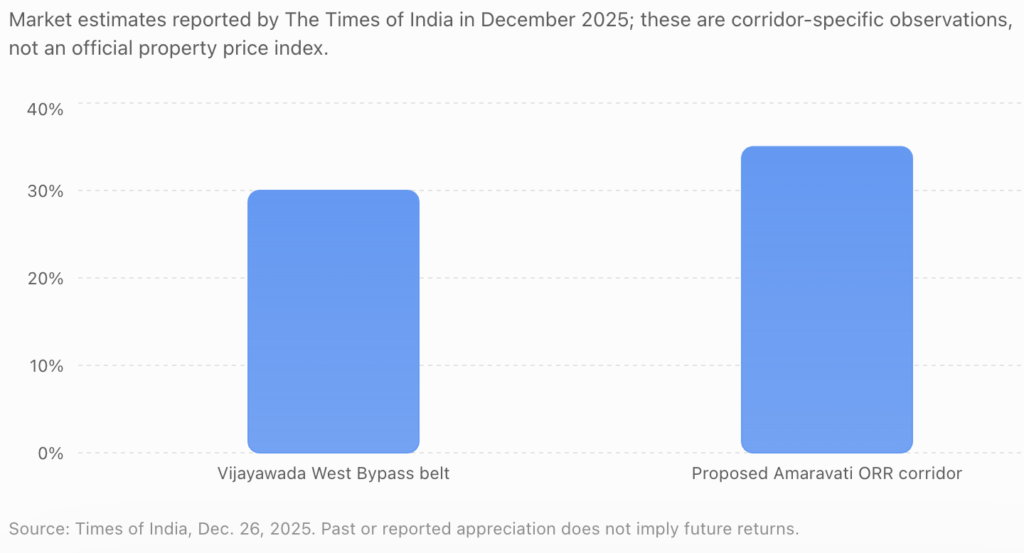
The most useful way to frame this comparison is not “which city will give the highest return?” but “which type of land-investment risk do you want to own?” Vijayawada already has urban demand, housing, commerce and transport infrastructure; Amaravati is a much larger policy- and infrastructure-led development thesis. Recent market reports show how strongly infrastructure announcements can affect both areas: land along Vijayawada’s West Bypass belt was reported to have risen about 30%, while some proposed Amaravati ORR corridors saw market estimates around 35%. These are reported micro-market movements, not official citywide price indices, so they should not be interpreted as guaranteed appreciation.
Property-market prices mentioned in this article are indicative asking prices drawn from publicly accessible property portals and should not be treated as official valuations, government guideline values or evidence of completed transactions. Infrastructure plans may change. Buyers should independently verify current master-plan zoning, approvals, title, encumbrances, road access and project alignments before investing.
Vijayawada vs Amaravati for Land Investment: Complete 2026 Comparison
Vijayawada vs Amaravati for land investment is no longer a simple comparison between an established city and a proposed capital. In 2026, the two real-estate markets are increasingly interconnected.
Vijayawada remains the established commercial and residential centre with existing neighbourhoods, employment, rental demand, highways, hospitals, educational institutions and everyday economic activity. Amaravati, on the other hand, represents one of India’s most ambitious greenfield urban-development stories—a planned capital whose investment case depends heavily on the execution of government institutions, roads, utilities, employment centres and supporting private development.
For a land investor, that creates two fundamentally different opportunities:
Vijayawada is primarily an existing-demand plus expansion story. Amaravati is primarily an infrastructure, institutional-development and future-demand story.
Neither is automatically the “better” investment.
The better choice depends on your budget, holding period, tolerance for uncertainty, plot location, legal quality and whether you value downside protection or maximum exposure to future capital-region development.
This guide examines Vijayawada vs Amaravati for land investment using official APCRDA information, World Bank documentation, NHAI-linked infrastructure developments, AP government property-verification systems and recent real-estate market reports.
Quick Answer: Vijayawada or Amaravati—which is better for land investment?
For many conservative and moderate-risk investors, well-located approved plots in Vijayawada‘s growth corridors may offer the more balanced investment proposition because the city already has an economic and residential base.
For investors with a longer horizon and greater tolerance for execution, policy and liquidity risk, carefully selected land or approved plots in Amaravati can offer greater exposure to capital-city-led transformation.
But buying “somewhere near Amaravati” merely because the capital is being developed is not an investment strategy.
Location, zoning, road access, title, approval status and the relationship of a particular plot to actual development matter far more than the word Amaravati appearing in an advertisement.
Vijayawada vs Amaravati: investment snapshot
| Factor | Vijayawada | Amaravati |
|---|---|---|
| Market type | Established city + expanding suburbs | Planned greenfield capital |
| Existing end-user demand | Stronger | Developing |
| Current urban infrastructure | More mature | Large-scale infrastructure under development |
| Rental ecosystem | Established | Still developing; spillover benefits Vijayawada/Tadepalli/Mangalagiri |
| Capital-city exposure | Indirect but significant | Direct |
| Policy dependence | Moderate | Higher |
| Infrastructure-led upside | High in selected corridors | Potentially very high |
| Price speculation risk | Moderate to high in hotspots | High in announcement-driven locations |
| Suitable holding period | Medium to long term | Generally long term |
| Liquidity | Usually better in established corridors | Highly location-dependent |
| Investor profile | Conservative/moderate | Moderate/aggressive |
| Due diligence required | High | Very high |
Important: This table is an investment framework, not a forecast of returns.
Why this comparison matters more now
Amaravati’s investment case changed materially when large-scale development funding and construction activity resumed.
In December 2024, the World Bank approved an $800 million Amaravati Integrated Urban Development Program. The Bank said Amaravati’s master plan covers approximately 217 sq km, with capacity envisaged for about 3.5 million residents by 2050. It also said the programme was expected to catalyse more than $600 million in private-sector investment.
The programme includes trunk infrastructure such as the road grid, public transport, flood mitigation, water and wastewater systems, community facilities and affordable housing. The World Bank also said Amaravati’s Social and Economic Masterplan estimates potential for 50,000 jobs over five years, particularly in construction, agro-processing, clean manufacturing and services.
APCRDA, meanwhile, continues to publish active tenders for infrastructure packages across numerous Amaravati villages, including Nidamarru, Neerukonda, Nekkallu, Thulluru, Nelapadu, Sakhamuru, Velagapudi, Mandadam, Rayapudi, Inavolu, Penumaka and Krishnayapalem.
This is important because the thesis for land investment in Amaravati increasingly rests on actual infrastructure execution rather than master-plan imagery alone.
At the same time, Vijayawada itself is gaining new transport infrastructure. By March 2026, the approximately 47-km, six-lane Vijayawada West Bypass had largely been opened to traffic, connecting Chinna Avutapalli toward Kaza and allowing through traffic on the NH-16/NH-65 network to bypass central Vijayawada.
The result is not necessarily “Vijayawada versus Amaravati.”
Increasingly, it is a Vijayawada–Amaravati metropolitan investment corridor.
Understanding the two investment stories
1. Vijayawada: investing in an existing city that is expanding
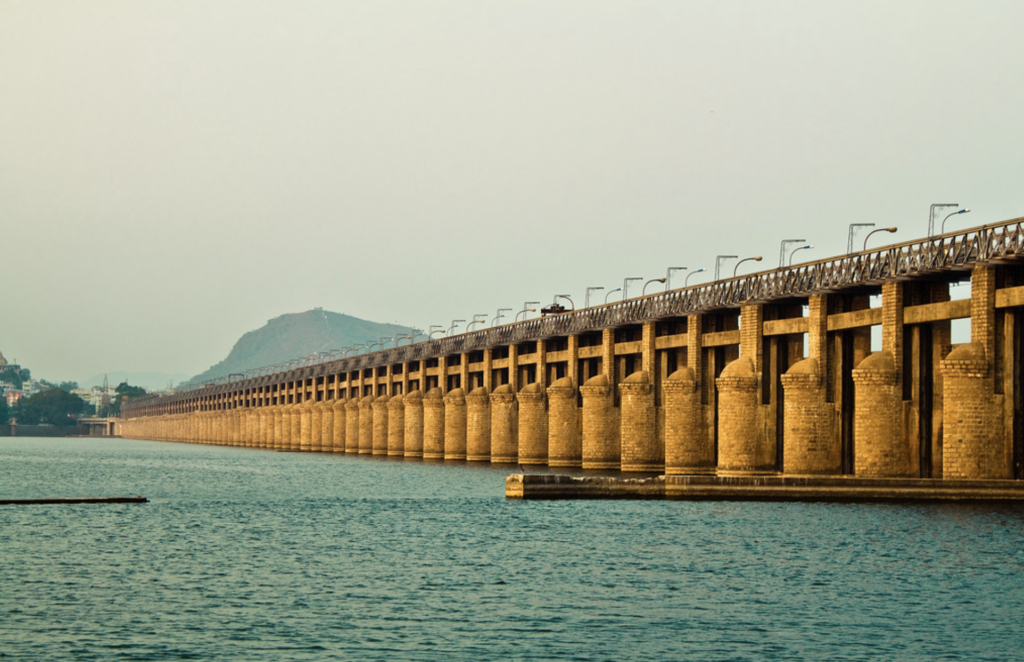
The strongest argument for land investment in Vijayawada is simple: investors do not have to wait for a city to appear.
Vijayawada already possesses established residential areas, commercial activity, employment, retail, healthcare, educational institutions and transport demand.
That gives land investors multiple possible future buyers:
- families building homes,
- local business owners,
- developers,
- employees relocating into the region,
- investors,
- commercial users,
- and buyers seeking better-connected suburban locations.
Recent developments in Amaravati can actually reinforce this advantage.
A September 2025 report described strong rental demand in Vijayawada as government and institutional activity connected to Amaravati increased demand for housing. The report specifically discussed accommodation requirements associated with institutions and employees moving into the wider capital region.
This demonstrates an important real-estate principle:
A new employment centre does not automatically capture all the housing demand it generates. Existing nearby cities often absorb the first wave.
Vijayawada is therefore capable of benefiting from Amaravati’s development without assuming every risk associated with buying directly inside an emerging greenfield city.
2. Amaravati: investing ahead of a planned capital-city economy

The thesis behind Amaravati real estate investment is very different.
The opportunity is not simply that land is available.
The investment thesis is that a major concentration of:
- government offices,
- administrative employment,
- roads,
- utilities,
- housing,
- institutions,
- businesses,
- services,
- educational activity,
- and private investment
could gradually transform presently underdeveloped areas into a functioning urban economy.
APCRDA says more than 25,000 landowners/farmers participated in Amaravati’s original land pooling process, involving more than 30,000 acres, with developed residential and commercial return plots forming part of the land-pooling model.
The World Bank describes the wider master-planned area as approximately 217 sq km and says around 100,000 people lived in the Amaravati area when its programme was approved, while the long-term plan can accommodate around 3.5 million people by 2050.
The scale is enormous.
And scale is precisely why Amaravati offers both higher perceived upside and higher execution risk.
A capital city cannot be valued purely on proposed road maps. It has to evolve from:
planned infrastructure → built infrastructure → functioning institutions → employment → residents → businesses → repeat property demand.
Investors entering earlier in that chain take more risk.
They may also capture more appreciation if execution succeeds.
Vijayawada vs Amaravati: the seven factors land investors should compare
Factor 1: Existing demand
Vijayawada advantage
Vijayawada already has everyday end-user demand.
That matters enormously when investing in plots.
Land appreciates sustainably when someone eventually wants to use it—not merely sell it to another investor.
A residential plot near functioning schools, hospitals, roads, shops, employment centres and populated neighbourhoods can have a broader resale market than undeveloped speculative land.
Amaravati position
Amaravati’s current investment proposition is more future-oriented.
Its end-user base is expected to expand as government activity, public institutions, housing and private development increase.
That means investors must distinguish between:
real demand that exists today
and
demand expected after future development.
Winner for current end-user demand: Vijayawada
Factor 2: Infrastructure upside
Here Amaravati becomes much more competitive.
The World Bank programme specifically includes road networks, public transportation, flood-management systems, water and wastewater infrastructure and neighbourhood facilities.
APCRDA’s current tender pipeline also shows infrastructure work distributed across numerous capital-city villages.
Another major catalyst is the proposed Amaravati Outer Ring Road.
A May 2026 report said NHAI had moved into the land-acquisition process for a planned approximately 189.4-km ORR crossing five districts.
Infrastructure of this scale can radically alter travel times, accessibility and land-use economics.
But investors should remember something important:
A proposed road creates speculation. An operational road creates utility.
The safest land-investment opportunities usually appear where the investor can identify both future infrastructure and existing connectivity, rather than relying entirely on a future project.
Vijayawada infrastructure upside
Vijayawada is not standing still.
The approximately 47-km West Bypass became largely operational in 2026, connecting major intercity corridors and reducing the need for through traffic to enter the city.
This improves the investment case for selected western and peripheral growth areas because accessibility can influence residential, logistics and commercial development.
Winner for transformational infrastructure potential: Amaravati
Winner for infrastructure already combined with an established city: Vijayawada
Factor 3: Risk of speculative pricing
This factor is frequently ignored.
A good location can still be a bad investment if you dramatically overpay.
The revival of Amaravati has already produced speculative price movement.
A December 2025 market report said land values along portions of the proposed ORR corridor had risen by roughly 35% according to market estimates, while Vijayawada’s West Bypass belt had seen increases of around 30%.
Those numbers should be interpreted carefully.
They are:
- not official transaction-price indices;
- not representative of every plot;
- not necessarily based on registered consideration values;
- not proof that another 30–35% rise will follow.
In fact, sharp appreciation before infrastructure is fully completed can increase investment risk because some future development may already be reflected in asking prices.
This is particularly important in plots in Amaravati advertised with phrases such as:
- “near capital”,
- “future government zone”,
- “near ORR”,
- “near proposed road”,
- “10 minutes from Amaravati”,
- “next Hyderabad”.
Those statements mean little without exact survey numbers, zoning information and measured connectivity.
Investment principle
Do not ask only:
“Will this area develop?”
Ask:
“How much future development is already priced into this plot?”
Factor 4: Policy and execution risk
Amaravati has experienced a highly unusual development cycle.
The market went through periods of very strong optimism, political uncertainty, stalled development and then renewed activity.
A late-2025 real-estate report explicitly described the earlier period of policy uncertainty and stalled projects before the subsequent revival.
That history matters.
Even with renewed financing and construction, a greenfield capital remains more dependent on:
- sustained government execution,
- infrastructure funding,
- administrative relocation,
- institutional occupation,
- development approvals,
- utility completion,
- private-sector participation,
- and long-term urbanisation.
Vijayawada is less dependent on any single government project because its economy and population already exist.
Winner for lower policy dependency: Vijayawada
Factor 5: Potential upside
This is where Amaravati attracts aggressive investors.
If a low-density or agricultural landscape becomes a functioning administrative and economic centre with several million residents over decades, land-use values can change dramatically.
The World Bank’s published scale illustrates the magnitude of the ambition: a 217 sq km master-planned capital with capacity for about 3.5 million people by 2050.
That does not mean every parcel around Amaravati will appreciate equally.
The strongest long-term locations are likely to be influenced by combinations of:
- proximity to employment,
- arterial-road access,
- permitted land use,
- infrastructure completion,
- population density,
- commercial activity,
- institutional development,
- scarcity of developable land.
Buying a random agricultural parcel 20 or 30 kilometres away and calling it an “Amaravati investment” is fundamentally different from buying a legally approved plot inside a clearly connected growth corridor.
Winner for maximum theoretical transformation upside: Amaravati
Factor 6: Liquidity and resale
Liquidity is one of the biggest hidden risks in plot investing.
A property may appear to be worth ₹X on paper, but its practical value to an investor is determined partly by how easily a genuine buyer will actually pay that price.
Established Vijayawada locations typically benefit from a wider universe of buyers because the property can appeal to both investors and users.
Emerging Amaravati areas may have a greater proportion of investor-to-investor transactions until housing, employment and commercial activity become deeper.
That can create a dangerous cycle in speculative micro-markets:
Investor buys because price is rising → another investor buys because price rose → infrastructure is delayed → investor demand slows → liquidity disappears.
Therefore, if resale flexibility is important within three to five years, an established Vijayawada growth corridor may be preferable to a very early-stage Amaravati location.
Winner for present liquidity: Vijayawada
Factor 7: Holding period
The shorter your investment horizon, the more existing demand matters.
0–3 years
Land is generally unsuitable for investors who absolutely need a fixed return within a short period.
Transaction expenses, market cycles and low liquidity can materially affect returns.
For a relatively short horizon, established Vijayawada plots normally make more strategic sense than highly speculative Amaravati land.
5–10 years
This is where the comparison becomes more balanced.
A well-selected Vijayawada growth corridor can benefit from urban expansion and Amaravati spillover.
A strong Amaravati location can benefit from substantial capital-city execution.
10+ years
For investors capable of waiting through development cycles, Amaravati becomes more interesting—but only if the land is legally sound and genuinely located within a durable urban-growth path.
The strongest case for investing in Vijayawada
People searching for plots for sale in Vijayawada sometimes assume the city’s biggest growth phase is already over.
That may be too simplistic.
A mature urban core often pushes development outward.
New roads and higher central land costs can redirect housing and commercial activity into peripheral areas.
The West Bypass is particularly important in this context.
By April 2026, most of the roughly 47-km six-lane Vijayawada West Bypass had been opened, improving movement between the NH-16 and NH-65 corridors without requiring through traffic to enter the urban core.
Market participants had already identified the West Bypass belt as an active micro-market, with nearly 20 major and minor ventures reportedly under development around the corridor by late 2025.
This creates an investment thesis based on three layers of demand:
Vijayawada’s existing economy + suburban expansion + Amaravati spillover.
That combination is arguably Vijayawada’s biggest competitive advantage.
Vijayawada locations investors should study
This is not a recommendation to purchase any particular property. Micro-location due diligence is essential.
Gollapudi and western Vijayawada
Gollapudi benefits from proximity to the West Bypass and NH-65 side of the urban region.
The wider western corridor may appeal to investors looking for:
- city adjacency,
- highway connectivity,
- residential expansion,
- logistics accessibility,
- future suburban growth.
Infrastructure changes have already increased investor attention to the West Bypass belt.
Kankipadu and south-eastern growth belt
Kankipadu sits within the broader Vijayawada capital-region planning geography; APCRDA publishes a proposed land-use/Zonal Development Plan for Kankipadu alongside other capital-region localities.
Investors here should focus particularly on:
- approved plotted developments,
- road width,
- access to Vijayawada,
- airport-side connectivity,
- drainage,
- surrounding habitation,
- actual rather than advertised distance to major roads.
Vijayawada–Mangalagiri–Tadepalli corridor
This may be one of the most strategically interesting belts because it connects an established city with the emerging capital ecosystem.
Tadepalli and Mangalagiri can potentially capture activity generated by both Vijayawada and Amaravati.
For investors uncomfortable choosing one market exclusively, corridor locations can represent a “middle path”:
more existing development than core greenfield Amaravati + stronger capital-city exposure than many Vijayawada suburbs.
The strongest case for investing in Amaravati
The core bullish argument for land investment in Amaravati can be summarised in one sentence:
Few Indian land markets have comparable exposure to the creation of an entire planned state-capital economy.
The World Bank’s $800 million programme adds institutional and financial credibility to the development effort and includes infrastructure essential to a functioning city.
By 2026, capital development had moved beyond conceptual planning, with APCRDA listing numerous active infrastructure procurement packages and recent reports describing ongoing government complexes, roads and housing-related construction.
This is materially different from buying land based solely on a distant master plan.
But the distinction between Amaravati and land marketed using the Amaravati name is critical.
Where Amaravati investors should focus
Rather than chasing village names, evaluate the plot using a hierarchy.
Tier 1: Legal and planning status
Before location attractiveness, verify:
- ownership,
- title chain,
- encumbrances,
- survey number,
- prohibited-property status,
- approved land use,
- layout approval,
- AP RERA status where applicable.
If these fail, proximity to the capital becomes irrelevant.
Tier 2: Functional connectivity
Measure:
- distance to a functioning arterial road,
- actual road width,
- directness of route,
- bridge dependence,
- access to Vijayawada,
- access to Mangalagiri/Tadepalli,
- future ORR relationship.
Do not rely on straight-line Google Maps distance alone.
Tier 3: Employment proximity
Land close to real employment generally has a stronger urbanisation thesis than land close merely to another plotted layout.
Look for genuine proximity to:
- government complexes,
- institutions,
- universities,
- business zones,
- hospitals,
- commercial districts,
- transport hubs.
Tier 4: Infrastructure visibility
Visit the site.
A road shown on a brochure is not the same thing as a road visible on the ground.
Check:
- carriageway formation,
- drainage,
- electricity,
- water,
- sewerage,
- street lighting,
- neighbouring construction,
- occupied homes.
Amaravati's biggest investment catalyst: institutional development
One reason Amaravati cannot be analysed like an ordinary plotted-development suburb is the scale of institutional relocation.
The capital is intended to function as the administrative centre of Andhra Pradesh.
The World Bank programme is explicitly designed around creating a functioning urban growth centre, including institutional capacity, infrastructure and job creation.
Once offices begin operating at scale, an economic multiplier can develop:
government employees → housing demand → schools and healthcare → retail and services → offices → hospitality → additional housing → higher land utilisation.
This is the process investors are effectively betting on.
The key uncertainty is the speed of that process.
Why Vijayawada may benefit even if Amaravati succeeds spectacularly
Investors often treat the two markets as substitutes.
They may actually be complements.
If Amaravati develops rapidly, Vijayawada can benefit through:
- housing demand,
- hotel demand,
- retail consumption,
- professional services,
- transport,
- education,
- healthcare,
- warehousing,
- commercial activity.
Evidence of this spillover was already appearing in Vijayawada’s rental market during 2025 as institutional activity related to Amaravati increased accommodation demand.
Therefore:
You do not necessarily have to buy land inside Amaravati to participate in Amaravati’s growth.
This is one of the strongest reasons some investors may prefer Vijayawada real estate investment.
the Amaravati development scale
| Metric | Published figure |
| Amaravati master-planned area | ~217 sq km |
| Long-term capacity | ~3.5 million people |
| World Bank programme | $800 million |
| Expected private investment catalysed | >$600 million |
| Potential jobs estimated over first five years | 50,000 |
| People targeted for direct skills training | 17,000 |
| Original land pooling participation | >25,000 landowners/farmers |
| Original land pooled | >30,000 acres |
Sources: World Bank and APCRDA.
What the numbers tell investors
The important conclusion is not that land prices must rise.
It is that Amaravati is being planned at a scale large enough to materially alter the economic geography of the Vijayawada–Guntur region if implementation progresses successfully.
Vijayawada vs Amaravati land prices: don't trust simplistic averages
Searches for land prices in Vijayawada or land prices in Amaravati frequently produce highly inconsistent figures.
That is unsurprising.
Land values can change drastically based on:
- road frontage,
- layout approval,
- plot dimensions,
- zoning,
- corner position,
- neighbourhood development,
- distance from highways,
- village boundaries,
- agricultural versus converted status,
- exact survey number.
A citywide “₹ per square yard” average can therefore be dangerously misleading.
For example, a legally approved residential plot on a developed road cannot reasonably be compared with an unconverted agricultural parcel merely because both are within the same mandal.
Better method
Compare five to ten genuinely similar plots using:
- registered-document information where available,
- current seller quotations,
- recent resale transactions,
- official guideline/basic values,
- local broker quotes,
- project approval status.
Then remove obvious outliers.
That provides a better micro-market picture than relying on one portal’s average asking price.
APCRDA-approved plots: why approvals matter
For investors buying plots near Vijayawada or Amaravati, planning approvals are one of the strongest risk filters.
APCRDA maintains master-plan and zonal-development information covering localities across the wider capital region.
Approval matters because it provides greater clarity about:
- permitted land use,
- road network,
- layout structure,
- open spaces,
- development rules,
- plot dimensions.
However, “APCRDA area” is not the same thing as “APCRDA-approved layout.”
Always verify the exact approval.
AP RERA verification
Andhra Pradesh RERA maintains project-level records that can include promoter details, project status, site information, development characteristics and registration information.
For plotted developments to which RERA requirements apply, buyers should independently verify the project on the regulator’s database rather than trusting a brochure containing a registration number.
Check that:
- the project name matches,
- promoter matches,
- location matches,
- survey numbers match,
- development type matches,
- promised completion details are consistent.
Title and encumbrance verification
The Andhra Pradesh Registration & Stamps Department’s IGRS portal provides services including EC Search, Certified Copy Search, Prohibited Property Search and property-wise transaction information.
These are important starting points—but they do not replace a professional title opinion.
For a meaningful land purchase, have an independent property lawyer examine the title chain and applicable approvals.
Beware of the "proposed infrastructure" trap
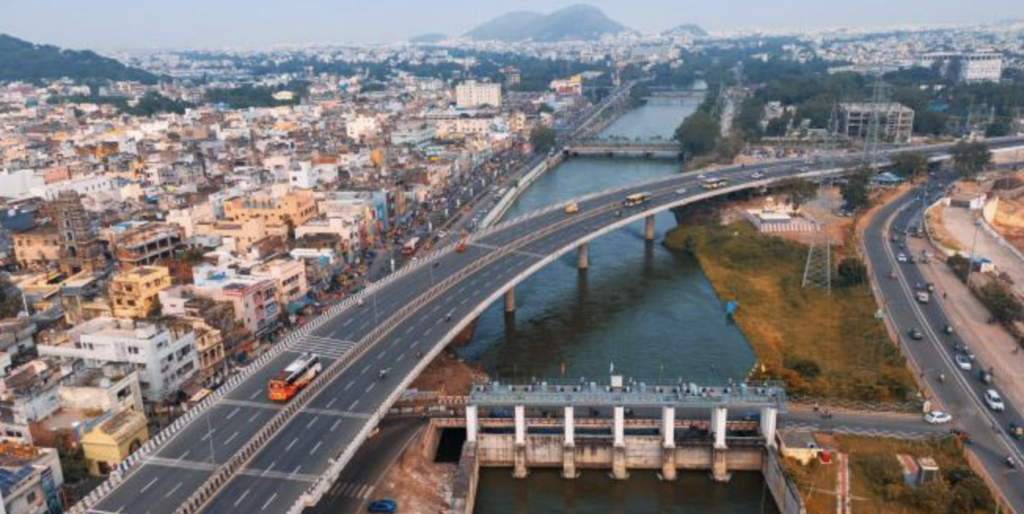
One of the most common mistakes in land investing is paying today’s premium for tomorrow’s infrastructure.
A broker may say:
“ORR is coming.”
That statement alone is insufficient.
Ask:
- Is the alignment final?
- Is land acquisition underway?
- Where is the nearest interchange?
- Can this plot directly access it?
- Could acquisition affect the property?
- Does the new road actually improve connectivity from this location?
- How much appreciation has already occurred because of the announcement?
For the Amaravati ORR, land acquisition activity had progressed by 2026, but that does not make every parcel near the proposed corridor equally valuable.
An interchange several kilometres away can be more valuable than land directly adjacent to a controlled-access expressway with no local entry.
Who should choose Vijayawada?
Vijayawada may suit you better if:
You want lower execution risk
You prefer a market where people already live and work.
Your holding period is around five years
You want a reasonably broad resale market.
You may eventually build
An established urban or suburban location makes self-use more practical.
You are a first-time land investor
Evaluating an existing neighbourhood is generally simpler than forecasting an entire future city.
You want Amaravati exposure without maximum Amaravati risk
Growth corridors connecting Vijayawada with the capital region may offer a compromise.
Who should choose Amaravati?
Amaravati may suit you better if:
You can hold for 10+ years
Large-scale urban transformation takes time.
You can tolerate volatility
Infrastructure-led markets can move sharply in both directions.
Your finances do not depend on quick resale
Liquidity can disappear during weak market cycles.
You understand planning documents
The difference between zoning categories, road alignments and layout approvals can materially affect returns.
You are buying close to real development
Not merely something advertised as “Amaravati side.”
A portfolio approach: Vijayawada + Amaravati
For investors with sufficient capital, this may be a better strategy than choosing one side completely.
For example:
Core holding — Vijayawada
Choose a legally approved plot in an established or rapidly expanding corridor.
Objective:
liquidity + existing demand + moderate appreciation
Growth holding — Amaravati
Choose a carefully researched location with direct exposure to planned capital-city development.
Objective:
higher long-term upside + infrastructure exposure
This produces a “core-and-growth” land portfolio rather than an all-or-nothing bet.
Vijayawada vs Amaravati: scenario analysis
Scenario 1: Amaravati develops faster than expected
Likely beneficiaries:
- well-located core Amaravati land,
- Tadepalli/Mangalagiri connectivity corridors,
- Vijayawada housing and rental markets,
- western/southern growth corridors with improved regional access.
In this scenario, Amaravati may generate the strongest percentage gains in selected locations, while Vijayawada benefits from economic spillover.
Scenario 2: Amaravati progresses steadily but gradually
This may actually favour Vijayawada investors.
Why?
Existing city demand continues while capital-region development adds incremental employment and housing demand.
Amaravati still appreciates in successful micro-markets, but investors may need longer holding periods.
Scenario 3: infrastructure execution experiences delays
Vijayawada would probably be comparatively more resilient because its underlying economy does not depend entirely on capital construction.
Speculative Amaravati land would face greater liquidity and sentiment risk.
Is Amaravati India's next Hyderabad?
This comparison is frequently used in real-estate marketing, but investors should treat it cautiously.
Hyderabad’s development occurred through decades of:
- employment creation,
- IT-sector expansion,
- population growth,
- infrastructure,
- private investment,
- housing development,
- institutional growth.
A master plan alone cannot reproduce that outcome.
Amaravati would need sustained economic execution.
The correct question is not:
“Can Amaravati become Hyderabad?”
It is:
“Which measurable development milestones would justify higher land values in the particular location I am considering?”
That is a far more useful investment question.
Final verdict: Vijayawada vs Amaravati for land investment
So, which is better—Vijayawada or Amaravati for land investment?
There is no universal winner.
Choose Vijayawada if you prioritise:
existing demand, better liquidity, current urban infrastructure and lower dependency on future capital-city execution.
For most conservative and first-time plot investors, Vijayawada is arguably the easier market to understand.
Choose Amaravati if you prioritise:
long-term transformation potential, direct capital-city exposure and potentially greater infrastructure-led upside.
But the higher-upside thesis comes with higher execution, policy, pricing and liquidity risks.
Our overall investment framework
| Investor type | Better starting point |
| First-time plot buyer | Vijayawada |
| Conservative investor | Vijayawada |
| 3–5 year horizon | Vijayawada |
| 5–10 year horizon | Vijayawada / strategic corridor |
| 10–15+ year investor | Amaravati becomes more compelling |
| Aggressive investor | Amaravati |
| Self-use + investment | Vijayawada |
| Pure capital-city exposure | Amaravati |
| Balanced strategy | Vijayawada–Amaravati corridor |
| Diversified high-budget investor | Both |
The biggest takeaway is this:
Don’t invest in Vijayawada because it is Vijayawada. Don’t invest in Amaravati because it is Amaravati. Invest in a legally clear plot positioned where infrastructure, accessibility, employment and real end-user demand are most likely to converge.
That principle is far more reliable than trying to predict which city name will become the bigger real-estate brand.
Frequently Asked Questions
Is Amaravati good for land investment in 2026?
Is Vijayawada good for plot investment?
Which has more appreciation potential: Vijayawada or Amaravati?
Is land near Amaravati ORR a good investment?
Is Vijayawada safer than Amaravati for investment?
Are APCRDA-approved plots safer?
What is the best area to invest in land near Vijayawada?

Consectetur sollicitudin cubilia facilisis lobortis lacus a ac phasellus. Mus pulvinar enim suspendisse pharetra id commodo platea nunc aliquet.
Categories

Residential environments built for tomorrow.
- +91 984 9411194
