Vijayawada Real Estate Market: Prices, Growth Corridors, Investment Outlook & Complete 2026 Guide
pavanmarripudihub@gmail.com
August 13, 2026
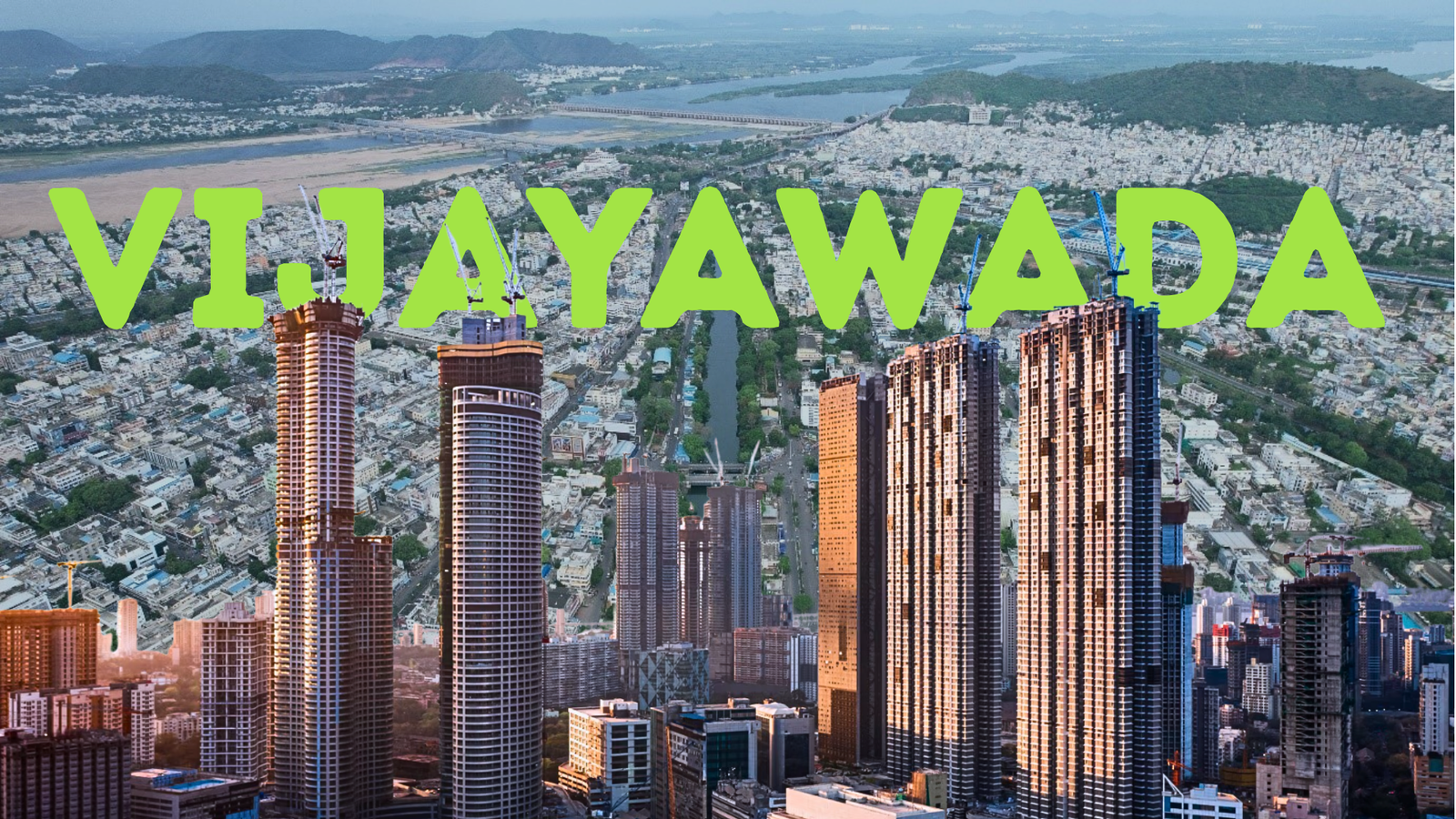
Vijayawada has always been one of Andhra Pradesh’s most important commercial centres. But the Vijayawada real estate market of 2026 needs to be understood differently from the market of a decade ago.
Today, Vijayawada sits at the centre of a much larger urban and economic story.
The city’s established commercial base is being supplemented by the development of Amaravati, increasing investment in the wider Capital Region, highway infrastructure, growing airport traffic and proposed mass-transit infrastructure. Together, these factors are gradually changing where people live, where businesses locate and – importantly for land buyers – where future development may spread.
At the same time, this is not a market where every plot automatically appreciates.
A residential plot near an established growth corridor, an APCRDA/competent-authority-approved layout with good road access, an agricultural parcel several kilometres from development and a small urban plot inside Vijayawada may all be advertised as “Vijayawada land”, but they are fundamentally different assets.
This guide examines the Vijayawada property market using government sources, infrastructure plans and current property-portal data to understand:
- Vijayawada property prices and land rates
- the strongest real-estate growth corridors
- the influence of Amaravati
- locations attracting residential development
- infrastructure that could affect land demand
- the case for investing in residential plots
- major risks investors should understand
- due diligence before buying land
- and the longer-term outlook for real estate in Vijayawada
Note: Property prices mentioned in this article are indicative asking/listing prices unless specifically identified otherwise. Portal prices are not the same as registered sale values, government market values or guaranteed achievable transaction prices.
Vijayawada Real Estate Market at a Glance
As of August 2026, Housing.com’s city-level price tracker reports an average asking price of approximately ₹5,908 per sq ft across property listed in Vijayawada, although the portal includes different residential property types and a very wide price distribution. Housing.com reported roughly 1,953 properties listed for sale when accessed.
For land specifically, Magicbricks reported more than 570 residential plots listed for sale in Vijayawada, with an average listing value around ₹69.9 lakh and a median around ₹36 lakh when accessed.
Those numbers immediately reveal something important:
There is no meaningful single “Vijayawada land rate”.
Prices depend heavily on:
- distance from the existing city
- road frontage
- neighbourhood maturity
- proximity to NH-16, NH-65 or major arterial roads
- airport accessibility
- relationship with the Amaravati–Mangalagiri–Tadepalli corridor
- layout approval
- plot dimensions
- commercial potential
- surrounding development
- developer reputation
- and legal clarity.
This is why serious analysis of the Vijayawada property market should happen at the micro-market level rather than simply comparing citywide averages.
Why Vijayawada Matters to Andhra Pradesh Real Estate
Vijayawada is already an established economic centre
Unlike a speculative satellite town dependent on one proposed infrastructure project, Vijayawada already has a functioning urban economy.
It serves as a major trading and business centre within the Andhra Pradesh Capital Region. APCRDA planning documents describe Vijayawada as a major trading and business centre within the wider capital-region framework.
This matters enormously for property.
Real-estate markets are generally more resilient when land demand is supported by multiple user groups:
- local families
- traders and entrepreneurs
- salaried employees
- government employees
- institutions
- developers
- businesses
- students
- healthcare workers
- commuters
- and investors.
Vijayawada therefore has an underlying property market independent of speculation surrounding Amaravati.
Amaravati can strengthen that base, but it does not create Vijayawada’s economic relevance from zero.
The Vijayawada–Amaravati Relationship

No analysis of the Vijayawada real estate market is complete without discussing Amaravati.
But it is equally important not to treat Vijayawada and Amaravati as the same real-estate market.
They are interconnected markets with different levels of maturity.
APCRDA’s official master-plan portal continues to publish planning documents for Amaravati, including the Detailed Master Plan and Government Complex zoning documentation.
The larger Andhra Pradesh Capital Region incorporates Vijayawada and neighbouring urban centres, which means infrastructure and employment generated by Amaravati can affect residential and land demand outside the formal capital-city boundary.
Why Amaravati matters to Vijayawada property
A functioning capital generates demand from:
- government departments
- public institutions
- professional services
- banks
- hospitality
- education
- healthcare
- contractors
- vendors
- retail
- housing
- transportation
- logistics
- and support services.
Not every employee working in the capital will necessarily live inside Amaravati.
Some may choose established locations in Vijayawada, Tadepalli, Mangalagiri, Kanuru, Poranki or other connected residential areas.
That creates what can be called a regional demand spillover effect.
Amaravati funding is now more tangible than it was during earlier speculative phases
The investment thesis around Amaravati has historically carried considerable political and execution risk.
That history should not be ignored.
However, the current phase differs in one important respect: substantial multilateral financing has been approved.
In December 2024, the World Bank approved an $800 million Amaravati Integrated Urban Development Program, intended to support development of Amaravati as a climate-resilient growth centre.
The Asian Development Bank has separately approved a $788.8 million results-based loan for development of Amaravati as a green and smart capital city.
By April 2026, reports citing officials indicated that World Bank funding had already begun being disbursed for Phase I works.
For a Vijayawada land buyer, this does not mean every surrounding village will appreciate rapidly.
It means the Amaravati story has moved further from purely announcement-driven speculation toward funded infrastructure execution.
That distinction matters.
Vijayawada's Real-Estate Geography: Think in Corridors, Not Just Localities
A useful way to understand the Vijayawada market is to divide it into several broad growth zones.
Zone 1: Established Vijayawada
This includes mature neighbourhoods and commercial areas in and around:
- Benz Circle
- MG Road
- Labbipet
- Patamata
- Machavaram
- Governorpet
- Moghalrajpuram
- Siddhartha Nagar and nearby established pockets.
These areas have stronger existing social infrastructure and commercial activity.
Land availability is naturally more restricted.
Properties here should therefore be evaluated primarily for:
- end-use
- redevelopment
- rental demand
- commercial potential
- or scarcity value.
They are not directly comparable with plotted developments on the outskirts.
For example, 99acres’ August 2026 locality data showed a very broad quoted land range for Benz Circle of roughly ₹2,200–₹8,750 per sq ft, illustrating just how dramatically individual properties can vary even within one premium market.
Zone 2: East and South-East Vijayawada — Kanuru, Poranki, Penamaluru, Tadigadapa
For residential buyers, this is one of the most important zones to understand.
Locations such as:
- Kanuru
- Poranki
- Penamaluru
- Tadigadapa
- Edupugallu
- nearby Bandar Road stretches
have progressively developed as residential extensions of Vijayawada.
They benefit from a combination of:
- proximity to established Vijayawada
- access to schools and hospitals
- road connectivity
- growing apartment development
- availability of larger land parcels compared with central Vijayawada
- and demand from families wanting newer residential communities.
Indicative portal asking rates
99acres showed land asking-price ranges of approximately:
| Locality | Indicative land asking range* |
|---|---|
| Kanuru | ₹3,650–₹5,400/sq ft |
| Poranki | ₹2,850–₹5,000/sq ft |
| Penamaluru | ₹2,800–₹3,350/sq ft |
*Portal asking-rate ranges when accessed in August 2026; not registered transaction prices.
This belt is particularly interesting because it demonstrates the transition from “outskirts” to functioning suburb.
That distinction is crucial for plot investors.
Land appreciation tends to become more durable when appreciation is accompanied by actual:
- houses
- apartments
- shops
- schools
- workplaces
- roads
- utilities
- and everyday population growth.
Zone 3: NH-16–Airport Corridor - Ramavarappadu, Kesarapalli and Gannavaram
The Vijayawada–Gannavaram corridor deserves special attention because it combines highway connectivity with airport-led development.
Gannavaram land listings tracked by 99acres were roughly in the ₹1,650–₹2,250 per sq ft range when accessed in August 2026.
Again, that should be treated as an asking-price indicator rather than a valuation.
The bigger story is infrastructure.
Vijayawada Airport Has Grown Dramatically
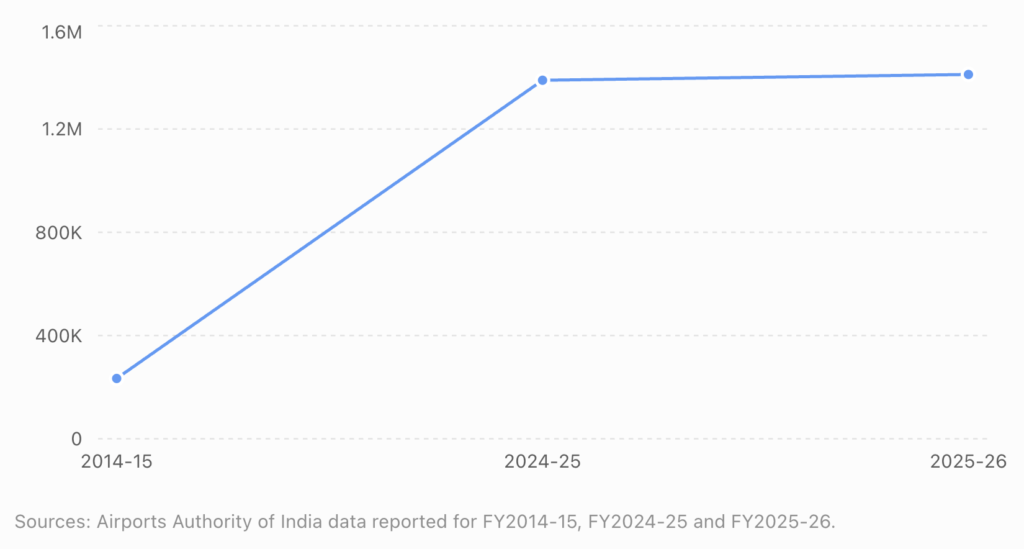
Vijayawada International Airport has experienced substantial passenger growth over the past decade.
Reported AAI traffic data show annual passenger volumes rising from roughly 2.33 lakh passengers in FY2014-15 to more than 14.11 lakh in FY2025-26 — an increase of more than 500% over the period.
This does not automatically produce residential land appreciation.
But airport growth can gradually support:
- hospitality
- warehousing
- transportation
- commercial activity
- offices
- employee housing
- logistics
- retail
- and improved regional accessibility.
Airport-oriented growth therefore strengthens the long-term case for carefully selected locations around Gannavaram and the NH-16 corridor.
The operative phrase is carefully selected.
Buying land “near the airport” without examining zoning, road access, development restrictions and actual distance can be highly speculative.
Zone 4: Western Vijayawada — Gollapudi, Jakkampudi, Kondapalli and Surroundings
Western Vijayawada has a different investment character.
Important areas include:
- Gollapudi
- Jakkampudi
- Ibrahimpatnam
- Kondapalli
- Guntupalli
- and surrounding corridors.
The region benefits from highway connectivity, industrial/logistical activity in parts of the belt and the gradual outward expansion of Vijayawada.
99acres showed approximately ₹1,750 per sq ft for land listings in Jakkampudi in its 2026 price tracker, though the sample size displayed was small.
Small sample sizes are precisely why buyers should never interpret portal averages as official valuation benchmarks.
Here, individual project quality can matter more than locality-level averages.
Zone 5: Vijayawada–Tadepalli–Mangalagiri–Amaravati Corridor
This is arguably the most strategically interesting — and potentially the most misunderstood — part of the wider market.
The corridor links an established commercial city with the developing state-capital ecosystem.
Potential beneficiaries include:
- Tadepalli
- Mangalagiri
- Undavalli
- peripheral capital-region villages
- and selected locations with strong connectivity to both Vijayawada and Amaravati.
99acres’ Tadepalli page showed land asking rates ranging approximately from ₹1,300 to ₹3,800 per sq ft, demonstrating a particularly wide variation by location and property quality.
Meanwhile, its Guntur market data placed Mangalagiri’s average displayed property rate around ₹3,300 per sq ft and indicated significant three-year appreciation, though this encompasses property types rather than providing a clean land transaction index.
The opportunity here is straightforward:
If Amaravati generates a large permanent employment and institutional base, the adjoining Vijayawada–Tadepalli–Mangalagiri urban corridor could experience increasing housing and commercial demand.
The risk is equally straightforward:
Capital-region branding can already be priced into land well before corresponding development reaches a particular parcel.
Investors should therefore pay for today’s location plus a reasonable amount for future potential — not for a hypothetical future city that already exists only in the seller’s quotation.
Infrastructure Will Be One of the Biggest Drivers of Vijayawada Real Estate
Real-estate investors frequently say “infrastructure is coming.”
A better question is:
What infrastructure, at what stage, funded by whom, and how exactly does it improve this property’s accessibility?
Several projects deserve attention.
1. Nagpur–Vijayawada Economic Corridor
The Ministry of Road Transport and Highways has highlighted the Nagpur–Vijayawada Economic Corridor, including the 90 km Khammam–Vijayawada access-controlled greenfield highway and 108 km Warangal–Khammam section. Together, those two projects were announced at an estimated cost of about ₹6,400 crore.
Improved inter-state road connectivity can strengthen Vijayawada’s role as:
- a distribution centre
- trading hub
- logistics node
- and regional business location.
For real estate, logistics and employment effects usually matter more than the highway announcement itself.
2. Vijayawada Bypass and NH-16 Connectivity
NHAI project documentation has included six-laning works for the Vijayawada bypass between Chinna Avutapalli and Gollapudi.
For land investors, bypass infrastructure can change accessibility patterns significantly.
Locations previously considered peripheral may become better connected to:
- the airport corridor
- western Vijayawada
- NH-16
- and inter-city traffic.
However, being physically close to a highway is not enough.
A plot with poor access to an interchange may receive little practical benefit despite being only a few kilometres from the road.
3. Vijayawada Metro Rail
Andhra Pradesh Metro Rail Corporation’s official Vijayawada project information describes a proposed Light Metro system.
Government documents for Phase I envisage two corridors with an estimated project cost of approximately ₹10,118 crore at January 2025 price levels. APMRCL also tendered for a General Consultant for the Vijayawada Metro Rail Project Phase I in April 2025.
The proposed Phase I network has been described in project documentation as approximately 38.4 km across two corridors.
This is potentially important for long-term urban form.
Metro systems can increase the attractiveness of well-connected residential nodes, but investors should distinguish between:
- proposed alignment,
- formally approved project,
- tendered works,
- construction,
- completed station,
- operational metro.
Those stages carry very different levels of certainty.
Therefore, a seller asking an enormous premium merely because a plot is “near future metro” deserves scrutiny.
What Is Actually Happening to Vijayawada Property Prices?
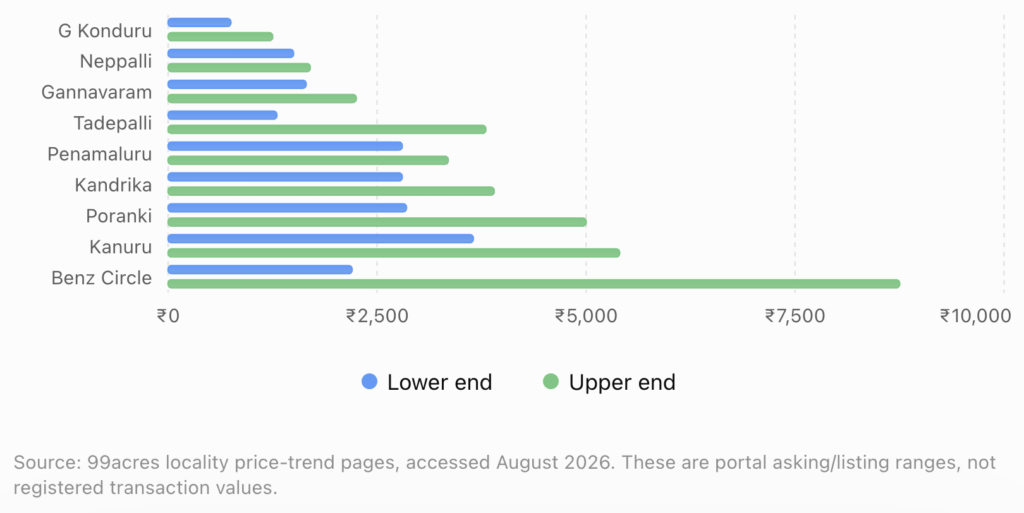
City-level asking-price indicators show a healthy but highly fragmented market.
Housing.com was showing an average residential property asking rate of approximately ₹5,908 per sq ft across Vijayawada when accessed in August 2026.
99acres displayed locality-level values such as approximately:
- Poranki: ₹5,500/sq ft on its broader property index
- Kanuru: ₹4,750/sq ft
- Kandrika: ₹3,200/sq ft in the locality-comparison data
- Payakapuram: ₹3,350/sq ft
with differing reported year-on-year movements.
These figures should not be mixed blindly.
Why?
Because property portals can include:
- plots
- flats
- builder floors
- houses
- resale properties
- new construction
- varying plot sizes
- different listing volumes.
That means the correct conclusion is not:
“Vijayawada land costs ₹X.”
The correct conclusion is:
Vijayawada has multiple sub-markets with materially different pricing, and individual property valuation must be performed locally.
That is a far more useful insight for buyers.
Why Residential Plots Remain Important in Vijayawada
Apartments dominate investment discussions in major Indian metros.
Vijayawada is different.
Residential land remains a meaningful part of the local property market.
Magicbricks alone showed more than 570 residential plot listings in Vijayawada when accessed, with a median asking value around ₹36 lakh.
That reflects several characteristics of the market.
1. Strong cultural preference for land ownership
Many Andhra Pradesh families continue to view a plot as a long-term family asset.
Unlike an apartment, vacant residential land does not physically depreciate through building ageing.
The land can also potentially be:
- held
- developed later
- transferred
- inherited
- combined
- or sold.
2. Vijayawada is still expanding horizontally
Because development extends beyond the mature core, new plotted layouts can emerge around growth corridors.
That gives plot investors opportunities that are increasingly scarce in heavily built-up metropolitan markets.
3. Infrastructure can re-rate peripheral land
A new road does not necessarily increase value.
But when infrastructure materially reduces travel time between peripheral land and:
- employment
- commercial centres
- schools
- hospitals
- airports
- government institutions,
the usable economic radius of a city expands.
That can convert peripheral land into suburban land.
This transition is one of the core mechanisms behind successful long-term plot investing.
But Plots Carry Risks Apartments Often Do Not
The flexibility of land is also what makes it more complicated.
A plot buyer must verify much more than price.
Potential issues include:
- unclear title
- disputed inheritance
- unapproved layout
- agricultural-to-residential conversion issues
- road-access disputes
- encumbrances
- mortgage
- acquisition risk
- incorrect survey boundaries
- zoning restrictions
- flood vulnerability
- misleading developer claims
- and resale liquidity.
This is why a cheaper plot is not necessarily a better investment.
APCRDA Approval, DTCP Approval and AP RERA: Do Not Treat Them as Marketing Stickers
One of the most searched phrases in the market is “APCRDA approved plots in Vijayawada.”
Buyers should understand what the relevant approval actually means rather than simply accepting a brochure logo.
The APCRDA website provides official planning, development-permission and capital-region resources.
The Andhra Pradesh Real Estate Regulatory Authority also provides project registration information through its official portal.
Before purchasing in a marketed project, independently verify the project’s status with the appropriate authority.
Do not rely solely on:
- a salesperson’s WhatsApp message
- a brochure
- a banner saying “approved”
- an approval-number screenshot
- or an intermediary’s verbal assurance.
Vijayawada Plot Buyer's Due-Diligence Checklist
Before paying a booking amount for plots for sale in Vijayawada, investigate at least the following.
1. Title
Ask a competent property lawyer to establish the chain of ownership.
Verify whether the seller actually has legal authority to transfer the land.
2. Encumbrance
Obtain the appropriate Encumbrance Certificate and investigate mortgages, charges and previous transactions.
An EC alone should not replace complete legal due diligence.
3. Survey number and physical boundaries
Match:
- title documents
- survey number
- approved plan
- measurements
- roads
- and the actual physical site.
4. Layout approval
Confirm the approval directly through the competent planning authority.
Never assume an entire venture is approved merely because one document mentions the survey number.
5. RERA registration where applicable
Search the official AP RERA portal and verify:
- promoter
- project
- registration
- declared completion timeline
- project information.
6. Land use and zoning
Confirm that intended residential usage is permitted.
An inexpensive agricultural parcel and an approved residential plot are not interchangeable investments.
7. Road access
Physically check the approach road.
Ask:
- Is it legally recorded?
- What is the approved road width?
- Who owns it?
- Does it connect to an existing public road?
- Is the road actually constructed?
A plotted layout can look attractive on paper and still be difficult to access.
8. Drainage and flood exposure
Vijayawada and the Krishna basin require serious attention to:
- elevation
- storm-water drainage
- nearby canals
- low-lying terrain
- waterlogging history.
Cheap land in a drainage-sensitive location can remain cheap for a reason.
9. Surrounding habitation
Count actual development.
Look for:
- occupied houses
- shops
- schools
- roads
- electricity
- water infrastructure
- apartment projects
- commercial construction.
Five occupied streets tell you more about a micro-market than fifty roadside venture hoardings.
10. Compare resale supply
Before buying a new plot, search for existing owners trying to resell plots in the same venture or neighbouring layouts.
If many sellers are available but very few end-users are building houses, the market may be investor-heavy.
That affects future liquidity.
The Most Important Metric Plot Investors Ignore: End-User Demand
Consider two layouts.
Layout A
- 300 plots sold
- 15 houses built
- minimal retail
- weak approach road
- mostly investor-owned.
Layout B
- 180 plots sold
- 70 houses built
- school nearby
- grocery stores operating
- public transport available
- good main-road connection.
Even if Layout A has more advertising, Layout B may have the healthier underlying property market.
Why?
Because real residents create real demand.
Investors trade expectations.
Residents create neighbourhoods.
The strongest long-term micro-markets eventually need both.
How to Judge a Vijayawada Plot Investment
A useful framework is to score a property across seven dimensions.
| Factor | Weight |
| Legal/title clarity | 25% |
| Existing connectivity | 15% |
| Location relative to employment/activity | 15% |
| Approved development & infrastructure | 15% |
| Existing habitation | 10% |
| Entry price versus nearby alternatives | 10% |
| Future infrastructure optionality | 10% |
Notice that “future project nearby” receives only 10%.
That is intentional.
A good plot should ideally make sense even if future infrastructure takes longer than expected.
Which Parts of Vijayawada May Suit Different Buyers?
For families planning to construct relatively soon
Prioritise areas with:
- established habitation
- schools
- healthcare
- shops
- public transport
- reliable road access.
Areas around Kanuru, Poranki, Penamaluru and other developed suburban neighbourhoods deserve consideration depending on budget.
For long-term land investors
Look at credible growth corridors where:
- development is moving outward
- major roads already exist or are under execution
- approved layouts are available
- residential demand is visible.
Potential research zones include:
- Gannavaram/NH-16 corridor
- selected western Vijayawada locations
- peripheral east/south-east residential belt
- strategically connected capital-region locations.
This is a research shortlist, not a blanket recommendation to buy anywhere within these localities.
For Amaravati-theme investors
Prioritise actual connectivity to:
- government complex
- trunk roads
- employment zones
- Vijayawada
- Mangalagiri
- Tadepalli.
Do not pay purely for the word “Amaravati” in a project’s branding.
What Could Drive the Vijayawada Real Estate Market Through the Next Decade?
Several structural themes could support demand.
1. Amaravati’s development
The World Bank and ADB commitments make capital development one of the largest structural drivers to monitor.
If government, institutional and private employment grows meaningfully, demand could extend across the wider Vijayawada–Guntur urban system.
2. Better inter-city road connectivity
The Nagpur–Vijayawada corridor and NH network can reinforce Vijayawada’s central logistical position.
3. Airport expansion and passenger growth
Passenger traffic of more than 14 lakh annually in FY2025-26 represents a significant increase from approximately 2.33 lakh in FY2014-15.
Continued aviation growth would strengthen Vijayawada’s accessibility to business travellers, NRIs and professionals.
4. Metro-led urban connectivity
If the proposed Vijayawada Metro progresses through execution and operations, it could materially change travel patterns across the metropolitan area.
The planned first phase is substantial enough that investors should monitor it — while continuing to distinguish planning from operational infrastructure.
Risks That Vijayawada Real-Estate Investors Should Not Ignore
A trustworthy market outlook must discuss downside scenarios as seriously as upside.
Risk 1: Infrastructure execution delays
Announced infrastructure can take years longer than expected.
Land purchased at a premium based on a future road, metro station or institutional zone can underperform if timelines slip.
Risk 2: Amaravati policy risk
The capital project has already experienced periods of policy change and delayed development.
Even though development has restarted and multilateral funding now provides stronger institutional backing, investors should retain a margin of safety rather than assuming a perfectly linear development path.
Risk 3: Excess speculative supply
Some outer areas can contain large numbers of plotted ventures without sufficient underlying housing demand.
When most buyers are investors hoping to sell to another investor, liquidity can disappear during weaker market cycles.
Risk 4: Asking price ≠ transaction price
Online portals tell us what sellers request.
They do not necessarily tell us what buyers eventually pay.
Registered transaction data, comparable recent transactions and local market investigation should therefore supplement portal research.
Risk 5: Paying tomorrow’s price today
This is perhaps the biggest danger.
A land parcel can be in a genuinely promising location and still be a poor investment if purchased too expensively.
Good location and good investment are not synonymous.
Price always matters.
Vijayawada vs Amaravati: Where Should an Investor Buy?
There is no universal winner.
Vijayawada
Potential advantages:
- established economy
- existing population
- mature social infrastructure
- stronger immediate end-user demand
- higher liquidity in established areas.
Potential disadvantage:
- higher entry costs in mature locations
- limited plotted inventory in core areas.
Amaravati/capital-region growth areas
Potential advantages:
- enormous planned infrastructure
- institutional development
- long-term urban expansion potential
- opportunity to enter earlier in selected locations.
Potential disadvantages:
- greater execution risk
- uneven development
- large differences between villages
- greater possibility of speculative pricing.
Practical conclusion
A conservative buyer may prefer established Vijayawada suburbs.
A longer-horizon investor with greater risk tolerance may investigate well-connected capital-region plots.
A balanced investor could seek the middle ground: locations with existing Vijayawada connectivity plus future Amaravati upside.
Are Plots for Sale in Vijayawada a Good Investment in 2026?
They can be.
But “buy land in Vijayawada” is far too broad to be useful advice.
A plot is attractive when several conditions come together:
Clean title + correct approval + usable road access + sensible entry price + genuine development + a credible future demand driver.
Remove two or three of those factors and the investment case changes dramatically.
The strongest opportunities are unlikely to be the layouts with the loudest marketing.
They are more likely to be properties where future growth is supported by today’s fundamentals.
A Simple Plot Investment Example
Suppose Plot A costs ₹30 lakh in a highly speculative layout.
Plot B costs ₹38 lakh in an approved layout where houses are already being built.
Plot A looks 21% cheaper.
But imagine the following:
| Factor | Plot A | Plot B |
| Main road access | Weak | Strong |
| Occupied homes nearby | Very few | Many |
| Approval | Needs verification | Verified |
| Shops/schools | Distant | Nearby |
| Development driver | Proposed project | Existing suburb + future infrastructure |
| Resale buyer pool | Mostly investors | Investors + end users |
The ₹8 lakh premium for Plot B may actually represent lower investment risk.
This is why plot comparison should never begin and end with price per square yard.
Frequently Asked Questions About Vijayawada Real Estate
What is the average property price in Vijayawada?
What are land prices in Vijayawada?
Which areas are developing around Vijayawada?
Is Gannavaram good for plot investment?
Will Amaravati increase Vijayawada property prices?
Is it better to buy a plot or flat in Vijayawada?
Are APCRDA-approved plots safer?
Consectetur sollicitudin cubilia facilisis lobortis lacus a ac phasellus. Mus pulvinar enim suspendisse pharetra id commodo platea nunc aliquet.